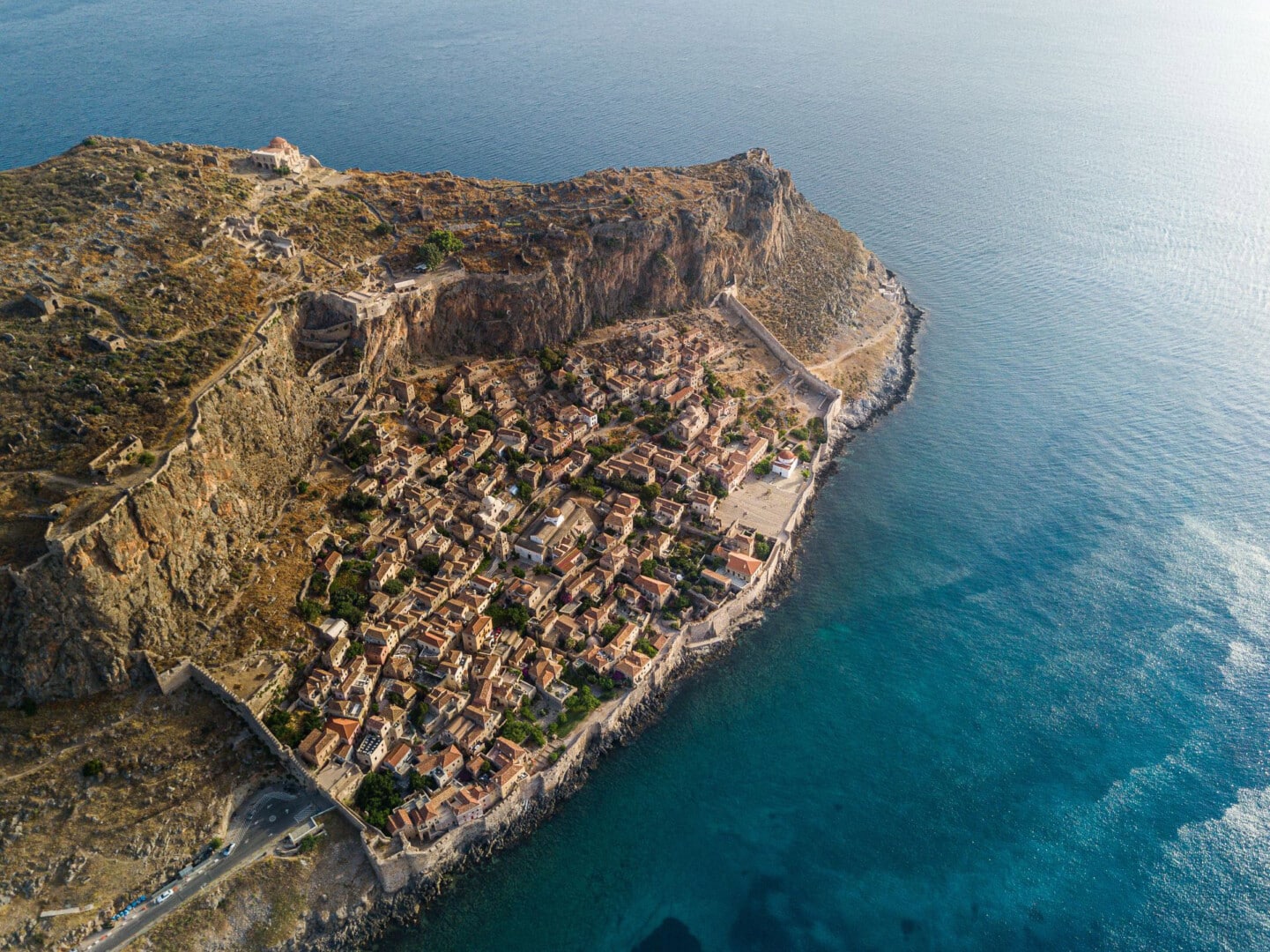

To cross the stone causeway connecting the Laconian coast to the sea-bound rock of Monemvasia is to step out of modern chronology entirely. Unlike open-air museums preserved behind ropes, the most captivating medieval towns in Greece are not silent relics of the past; they are living, breathing spaces where life continues inside centuries-old stone walls. In these fortified havens, residential homes still shelter local families, iron-studded doors open into quiet artisan workshops, and modern travelers walk along the same polished cobbles once tread by Byzantine merchants, Venetian captains, and Ottoman garrisons.
Five Medieval Towns in Greece Worth Discovering
While Greece is celebrated worldwide for its ancient classical ruins and sun-drenched island villages, its medieval heritage tells a deeply atmospheric story of defense, trade, and cultural convergence. As international interest turns toward historic regional fortresses of Greece, the Peloponnese is capturing the global imagination as the cinematic backdrop for films like The Return and Christopher Nolan’s The Odyssey, with certain scenes being filmed in places like Methoni and Pylos. Greece’s stone citadels have never felt more resonant.
Exploring these historic settlements offers a tangible connection to the past, especially when paired with a stay at a historic countryside mansion like Kinsterna Hotel, where ancient estate life and Laconian hospitality mirror the timeless rhythms of the region.
From Laconian sea fortresses to Aegean mastic strongholds, these five destinations reveal a side of Greek history where centuries-old stone walls still cradle daily life.
Monemvasia: The Living Fortress of Laconia
Protected as a premier national monument and acclaimed European heritage landmark, Monemvasia stands as an authentic citadel representing centuries of continuous Laconian defense and maritime power. Rising dramatically from the Myrtoan Sea of the Peloponnese, Monemvasia (derived from the Greek Moni Emvasis, meaning “single entrance”) is perhaps the most iconic of all fortified towns in Greece. Founded in the 6th century by Laconians seeking refuge from Slavic invasions, this massive limestone plateau was far more than a scenic retreat; it evolved into a vital Byzantine naval stronghold and a booming commercial hub. It was also the birthplace of Malvasia, the legendary sweet wine exported by Venetian merchants that dominated royal European tables for four centuries.
Through successive eras of Byzantine, Venetian, and Ottoman rule, the citadel withstood countless sieges due to its self-sustaining agricultural terraces on the upper plateau and its single, heavily defended causeway. Entering through the solitary stone gateway today reveals one of the most remarkable inhabited medieval towns in Greece, where this multilayered history remains etched into every surface.
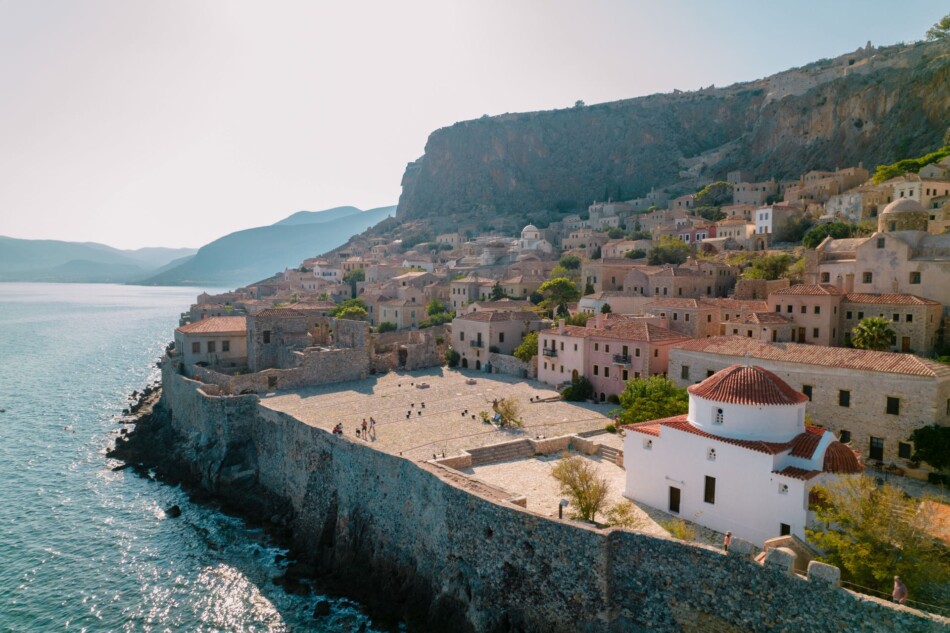
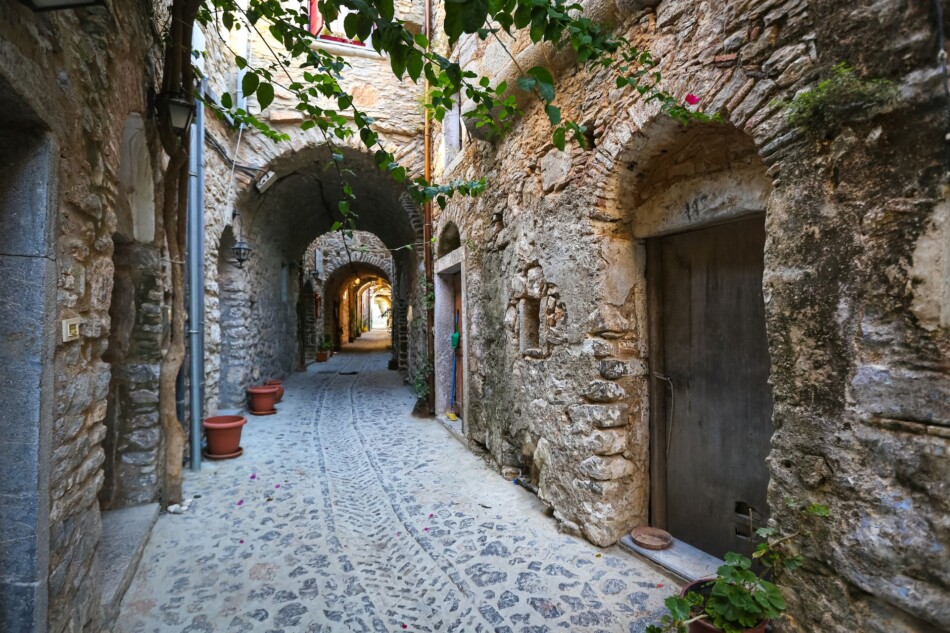
In the Lower Town, restored Venetian mansions and Byzantine structures line the narrow kalderimia (cobblestone alleyways) and low stone archways (dromiki), now housing quiet cafes, family-run taverns, and artisan shops. A steep climb up the zigzagging path to the Upper Town offers complete silence, sweeping sea views, and access to the 12th-century Church of Agia Sophia, an architectural masterpiece standing on the cliff edge as a testament to the town’s Golden Age.
Methoni Castle: Legendary Fortresses of the Coast
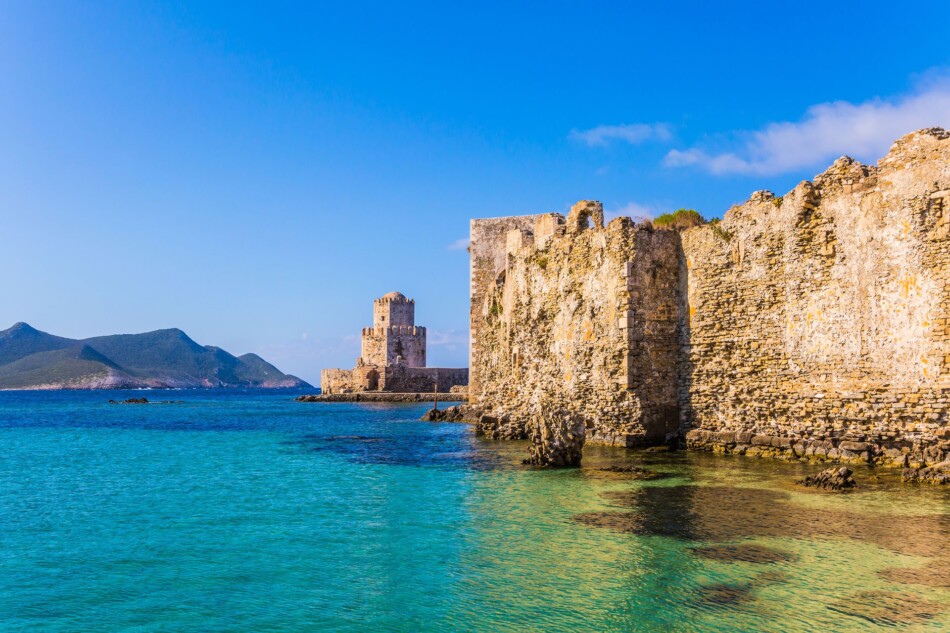
Set along the southwestern tip of the Peloponnese, Methoni Castle stands as one of the most remarkable sea fortresses in the Mediterranean. Connected to the mainland by a striking stone arch bridge, its sea-bound Bourtzi tower rises directly out of the water.
First fortified by the Venetians in 1209 as a vital maritime outpost, the castle’s immense stone ramparts have weathered over eight centuries of battles and sieges. That timeless, cinematic atmosphere recently brought the fortress back into the global spotlight, serving as a primary filming location for scenes in Christopher Nolan’s The Odyssey. Walking through its massive arched gateways, you feel an immediate, visceral connection to both ancient Greek myth and centuries of Mediterranean history.
Mystras: The Byzantine Citadel of the Morea
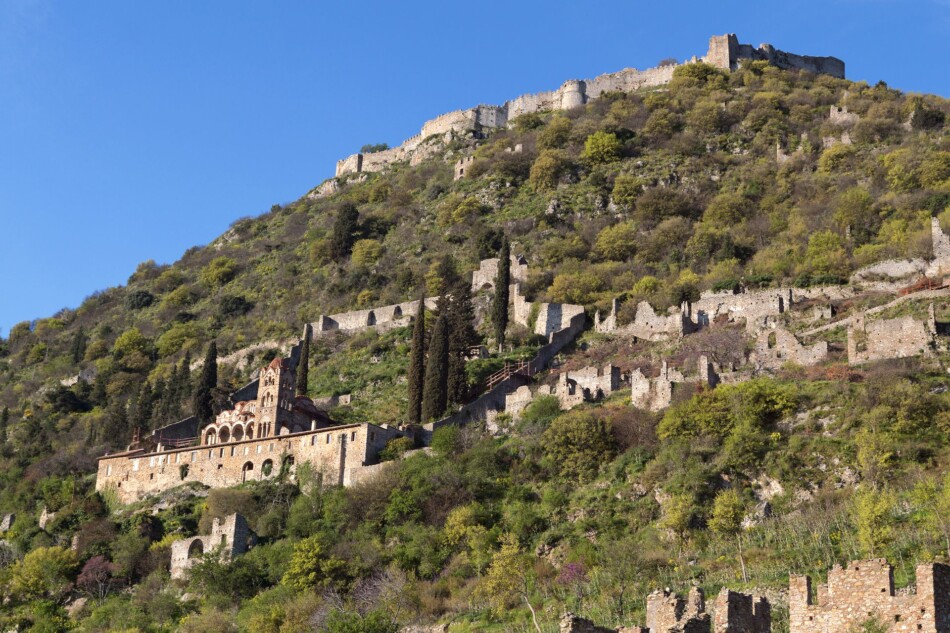
Designated a UNESCO World Heritage Site in 1989, Mystras is revered as the ultimate surviving political, artistic, and intellectual capital of the late Byzantine Empire. Perched on the steep slopes of Mount Taygetos, it stands among the premier Byzantine towns in Greece. Founded in 1249 by the Frankish prince William II of Villehardouin following the Fourth Crusade, the citadel was soon surrendered to the Byzantine Empire, transforming into the brilliant capital of the Despotate of the Morea. In the 14th and 15th centuries, Mystras became the intellectual beacon of the late Byzantine world, fostering a cultural renaissance led by philosophers like Gemistus Pletho and serving as the seat where Constantine XI Palaiologos, the last Byzantine emperor, was crowned in 1449.
While the monumental Palace of the Despots and upper aristocratic quarters rest as protected archaeological treasures, Mystras retains a living pulse through the Pantanassa Monastery. Built in 1428, this architectural gem remains an active convent where a small order of nuns tends to blooming courtyards and preserves some of the most vibrant, expressive frescoes of the late Byzantine period. Winding past domed churches and beneath stone archways while listening to the wind rustle through Mount Taygetos offers a profound glimpse into the final flourish of Byzantine civilization.
Mesta: Chios’s Defensive Mastic Fortress
While preserved as a protected medieval settlement, Mesta’s identity is linked to the island’s traditional mastic cultivation, recognized on UNESCO’s Representative List of Intangible Cultural Heritage. Engineered in the 14th century by the Genoese mercantile company Maona, Mesta was constructed as a fortified, self-contained settlement designed exclusively to protect the extraction and trade of mastic, a rare tree resin so valuable it was treated as currency across Mediterranean empires.
To thwart constant attacks from Aegean pirates, Genoese engineers built Mesta without exterior windows or doors on its ground-floor outer perimeter, turning the outermost homes into a continuous ring of defensive walls. Inside, the village formed an intricate defense matrix of narrow, vaulted alleyways. Rooftops were intentionally connected by high stone bridges, allowing the entire population to retreat to the massive central watchtower elevated above the street grid during an invasion. Today, Mesta remains a fully functioning village where daily life unfolds within this 700-year-old stone grid, as locals gather in the central livadi (square) under plane trees to share estate wine and regional spirits.
Rhodes Old Town: The Living Citadel of the Knights
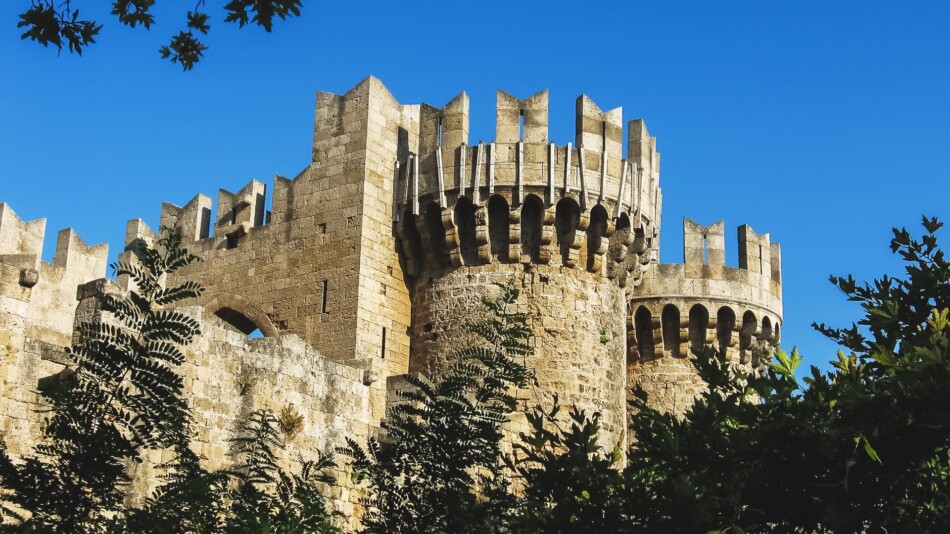
Inscribed as a UNESCO World Heritage Site in 1988, Rhodes Old Town is celebrated as one of the best-preserved medieval Crusader strongholds in Europe. Enclosed within a four-kilometer ring of massive stone walls, dry moats, and bastions constructed by the Order of St. John of Jerusalem between 1309 and 1522, it stands as Europe’s oldest continuously inhabited medieval city. Serving as the Order’s headquarters during the Crusades, the city successfully repelled massive Ottoman sieges, including the famous assault of 1480, before eventually capitulating to Sultan Suleiman the Magnificent in 1522 after a grueling six-month campaign.
Walking down the famous Street of the Knights, past the Gothic inns (auberges) representing the different national divisions of the Order, leads directly to the monumental Palace of the Grand Master. Yet, despite its grand military history, the citadel never turned into a museum. Today, nearly 6,000 residents live within the ancient walls. Children play in sunlit Ottoman-era squares, local artisans practice ancient copper-smithing in vaulted workshops, and family taverns spill out onto stone alleyways, demonstrating how centuries of Crusader, Ottoman, and Italian architectural heritage continue to serve as the backdrop for daily island life.
Experiencing Greece’s Fortified Heritage
Exploring these historic towns requires a change of pace. Because their layout was designed to deter invaders and accommodate foot traffic, the best way to experience them is simply to slow down:
Wear supportive footwear: Polished marble and centuries-old stone cobbles can be uneven and slick.
Visit in the shoulder seasons: Spring and late autumn bring mild temperatures, quiet alleyways, and optimal light for appreciating the stone masonry.
Respect the residential rhythm: Remember that these are living communities; keep noise levels low in the early afternoon and late evening hours.